

Please see our Home Page
In December 2001 further enormous areas of land were being prepared at Kings Caple by Neil Cockburn of Pennoxstone
Court in preparation for erecting more polytunnels. This is within the designated lower
Wye Valley Area Of Outstanding Natural Beauty and an area of
great landscape value.
Individuals, the parish council and our MP had previously written to the council
expressing their concern at this serious destruction of landscape within the AONB.
At that time we believed the council were powerless to stop this.
Discussion document, submitted to the council 30th January 2002 (appears here in revised form):
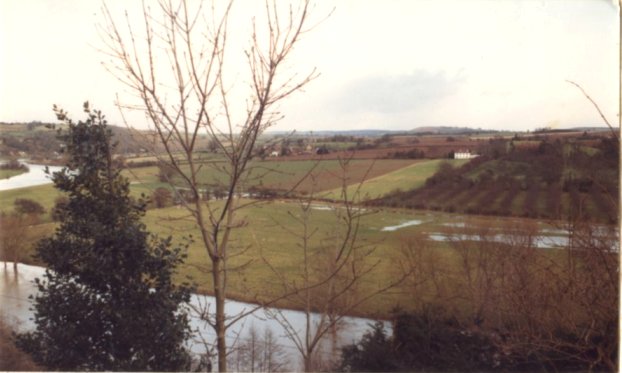
photo: pre-polythene days at Kings Caple alongside river Wye
Loss of Landscape
The beauty of the English landscape in particular the Wye Valley lies in its
subtle blend of colour and light, muted green, red brown of soil, small fields, hedgerows
and a rich variety of trees. a gentle undulating landscape where from the top of a hill
views of twenty or thirty miles can be seen.
The glaring, jarring, white of a single polytunnel disturbs the eye and becomes a
prominent feature; a whole field then another and another gives it all the appearance of a
semi-industrial wasteland. This seriously degrades the landscape and is incompatible with
a designated AONB.
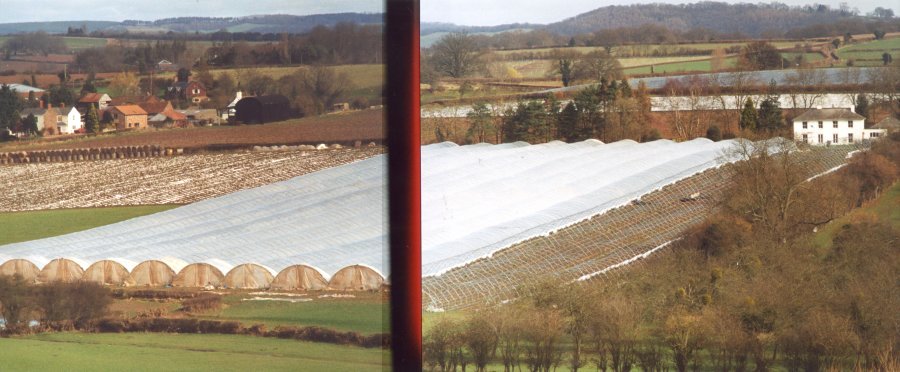
photo: now Kings Caple alongside river Wye is more akin to an industrial estate
Those Concerned.
Despite its clear visibility the authorities apparently decline to see it or feel the need
to act the Parish Council and Member of Parliament and individuals have alerted
Herefordshire Council and the Offices of the AONB to the ever-growing disquiet.
Present Position.
As far as I am aware the position of Herefordshire Council remains as stated in
their letter 12th April 2000.
1a. Herefordshire Council Planning Authority does not have powers to control the type of
polythene tunnels being erected at Pennoxstone, Kings Caple.
2a. Herefordshire Council Planning Authority is not seeking to gain any such powers as the
current controls are as laid down within the Town and Country Planning act 1991(as
amended). It would be a matter for central government to undertake any revision of the
Act.
Questions of Legality
Their general assumption has been Polytunnels fall outside building/planning
regulation primarily because they do not have concrete foundation. They are classed as
temporary building and within the classification of farming and on the face of it are
outside planning control. However even when this was an assumption, this is not clear-cut
as Sir Paul Beresford advised. “ There are no hard and fast rules”
Herefordshire Council have been informed that there was indeed a way forward due to the
case of” Skerrits of Nottingham Ltd v. Secretary of State for the
Environment”March 22 2000. This case overturns previous laws on the subject of
“temporary” structures and, on the face of it, was the blue print for
introducing controls over polytunnels
Most importantly however is Chichester Council against the Brinkman Brothers planning
appeal decision, a copy of which I forwarded to the Council 26th Feb 2002
Defend or Deregister the AONB
Where this method of farming is being used the incumbent authorities need to
consider the detrimental effects this is having and it is encumbered upon them to seek
solution. It is hypocritical and irresponsible
to have vast acres of land falling under plastic farming whilst still maintaining that the
area should continue to enjoy the status of AONB.
1a. Action should be taken to defend the environment and maintain it truly as that of
outstanding beauty
2a. To deregister it as an AONB but as Andrew Blake AONB Officer advised there is
currently no mechanism for “deselecting”.
Terms and Phrases
Below are some of the issues and terms that are used in an attempt to quash or
dismiss the argument or which are inherently misleading.
1b. "Temporary Structure”
It has been said that the use of polythene sheet and tunnel is” temporary” used
at times to warm the soil, to protect crop during adverse weather, to bring about an early
crop etc. Although true, it does stretch the definition of temporary. These tunnels are no
longer just raised in early summer; they are now a permanent twelve-month feature, evident
in December as well as in August. To call
them temporary structures because they do not have concrete footing would appear to be
irrelevant. This view has been upheld by current legislation (ref. Skerrits of Nottingham
v. Sec of State for the Environment, March 2000) and the Brinkman Appeal decision
2b. ”Plastic greenhouse”
It has to be clear, we are not talking with regard to horticulture, a single tunnel in a
garden, but rows upon rows, miles upon miles, field upon field, acre upon acre, in
undulating landscape not concealed by hedge or trees, glaring white- in-your- face
plastic. At Pennoxstone approx twenty thousand hoops = forty miles of tunnel.
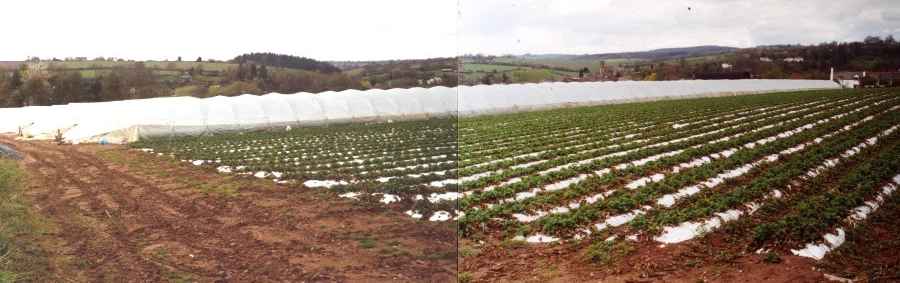
photo: polytunnels at Kings Caple along footpath KC16
3b. ”Strawberries have to have the protection of the polytunnel
in order to grow in the English climate”
There are other and bigger and successful strawberry growers only a few miles away near
Ross on Wye who refuse the use of the polytunnel on the grounds that it is an ugly
intrusion into the landscape.
4b. ”The use of polythene is only a passing phase, as more and more farmers use it
and contest with prices then it will bottom out as they say”
The use of polythene as any one who has stepped off the plane in the south of Spain will
witness has all but bottomed out. In parts the entire coast line is covered in plastic.
This should be seen as a portent of the future here in this traditional fruit growing
area. Look to the left whilst going south on
the Monmouth road just outside Ross and see the newly erected “Hundred Mile”
tunnel and other examples follow.

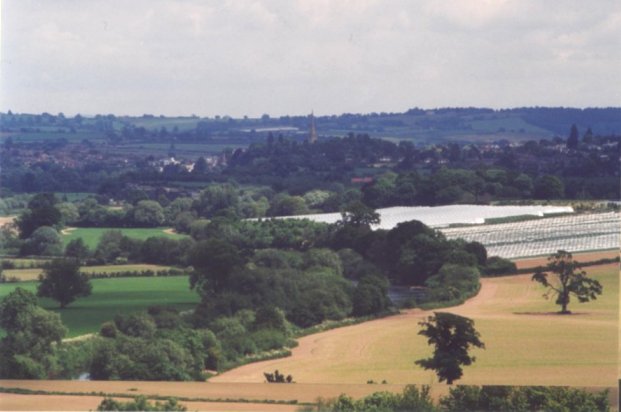
photo: Ross-on-Wye, the Spires of St
Mary now dominated by fields of plastic
1½ miles to the south lies Goodrich Castle and to the rear Chase Wood. This
development is against the whole ethos of the AONB.
Polytunnels erected at by Mr Drummond at The Homme, Walford, alongside the River Wye,
opposite Pencraig, approx 150acre site clearly visible from the A40 Ross-Monmouth.
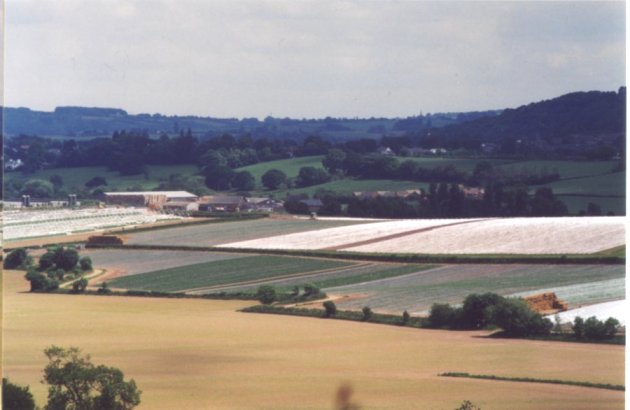
photo
1
photo
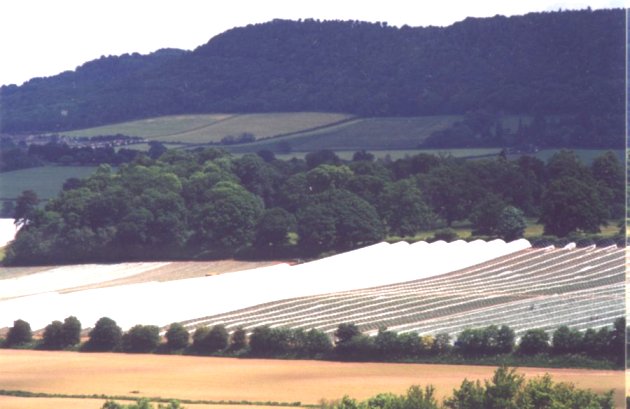
2
photo
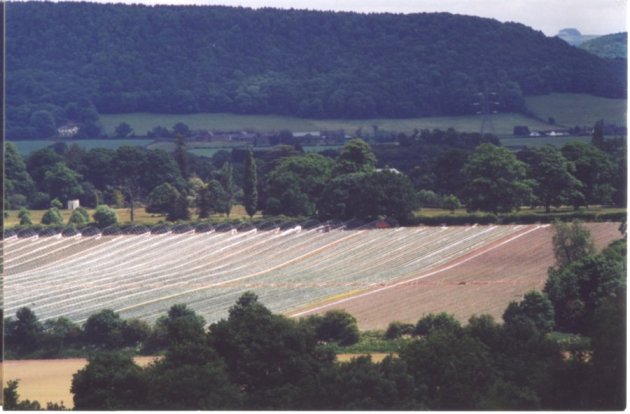
3
photo
4
These photographs Illustrate the growers process of first covering land with polythene then raising hoops then plastic tunnel. This is neither a “Temporary Structure” nor a temporary business; this is a permanent and expanding feature in the Area of Outstanding Natural Beauty, all year, year upon year.
Planning policy; Prominent views to and from hillsides and across open countryside or towns are protected from the intrusion of large-scale development. The setting of historic and attractive man-made features such as cathedrals, churches and notable buildings should therefore be protected”
All without planning consent!
5b. ”The use of tunnels is helping to support the local
economy:-
No doubt that the working of raising tunnel employs more hands on but the vast numbers of
fruit pickers/workers are drawn from Eastern Europe. Pennoxstone made the TV news
imploring the government to extend the visas of their pickers so as not to loose the crop.
As late as 1990 local pickers had been employed and paid well which was an obvious way of
supporting the local economy.(Should we not encourage farmers who TRULY support the local
economy.)
6b. ”Fruit farmers are only earning a living”
Indeed there must be considerable profits to be made by individual farmers using this form
of intensive farming. The repercussions are financial loss to those living in the
vicinity. Nothing hurts more than to sink all your life’s savings in a house in the
middle of the most beautiful of English landscapes with unparalleled views and to wake up
surrounded by giant hoops of white polythene stretching off in all directions
7b. ”Loyalties to the farmer”
Who is not aware and has empathy for of the plight of the farmer?
It is not that we do not care for the plight of the farmer it is that we care for the
landscape more.
We object when industry pollutes our waters with chemical emissions.
We object when the hospital protects the bad surgeon.
Polytunnel farming damages the visual landscape if not the soil and in these terms it is
bad farming
Erecting10 ft high polytunnels across the windows of a house were the occupiers previously
enjoyed unparalleled views over the Wye Valley is ANTI SOCIAL.
Regulation is the means by which we protect the environment from the self-interest of an
individual or commerce, be it the farmer or the supermarket
By taking the attitude that these are outside planning consents the Council have deprived
the individual from making representation to curb the worst excesses of this method of
fruit production and to object totally to its use in an AONB.
Additional Matters
Tourism and Loss to the community
The former glory of this once beautiful environment is remembered by those who chose to
come and